
Categories
Home Selling, Seller Advice, Selling a Home, Selling Your HomePublished September 2, 2026
Can a Surviving Spouse Sell the House in Texas Without Probate?

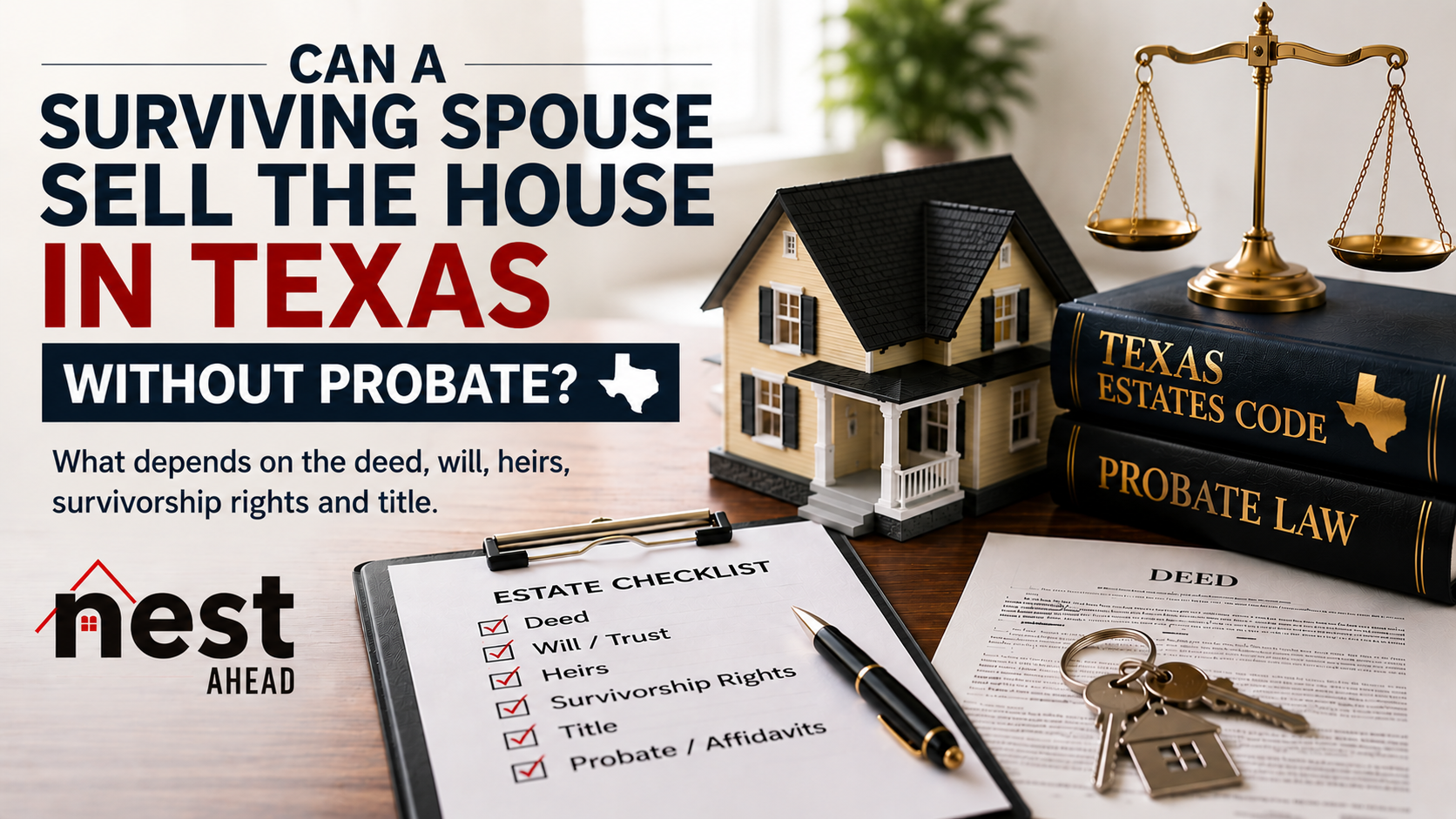
Can you sell your Texas home after your spouse dies without going through probate?
There is not one answer that applies to every Texas property or estate.
Whether a home can be sold without a traditional probate proceeding can depend on the property's ownership, estate-planning documents, the deceased owner's estate and other circumstances.
A qualified Texas probate or estate attorney should determine whether probate or another legal procedure is necessary in a particular situation, while the title company can identify its requirements for insuring title in the proposed sale.
That is why the first question usually should not be, “Do I need probate?”
A better starting point is:
“What ownership, estate and title issues need to be reviewed before this property can be sold?”
Being the surviving spouse does not automatically answer the title question
A surviving spouse should not assume that marriage alone means he or she now owns 100% of the property or has sole authority to sell it.
The ownership and estate analysis can depend on:
- the deed;
- how the property was characterized;
- the deceased spouse's will;
- survivorship agreements;
- transfer on death deeds or other estate-planning arrangements;
- the deceased spouse's heirs;
- family circumstances; and
- any probate or estate proceeding already underway.
Those are legal and title questions. A qualified Texas attorney should determine how the law applies to the specific situation, and the title company can identify the documentation it requires for the proposed sale.
Why isn't probate required in every situation?
Different Texas estates can require different procedures.
Some property may pass under estate-planning arrangements or other mechanisms that do not involve a traditional probate administration.
Determining whether that has occurred, and what legal procedure is appropriate, is a legal question that should be addressed by a qualified Texas probate or estate attorney.
A REALTOR® should not advise a surviving spouse whether probate is required or recommend a particular estate procedure.
What if there is a right of survivorship?
Survivorship provisions can affect what happens to an ownership interest after one owner dies.
But the legal effect of any survivorship language depends on the actual documents and circumstances.
If you believe the property has survivorship provisions, have the recorded documents reviewed by a qualified Texas attorney and provide them to the title company for its title review.
Do not assume that simply having two names on a deed produces a particular legal result.
What if there is a transfer on death deed?
A Transfer on Death Deed is another estate-planning document that may affect Texas real property after an owner's death.
If one exists, the recorded document should be provided to the appropriate legal and title professionals for review.
A REALTOR® should not interpret the document or tell the surviving spouse what ownership interest it created.
The title company can identify what documentation it requires before insuring a future sale.
What if my spouse had a will?
A will is an important estate document, but finding a signed will does not necessarily answer every question that matters in a real estate transaction.
Depending on the circumstances, additional legal steps may be necessary before the deceased spouse's interest can be conveyed.
A qualified Texas probate or estate attorney should determine what legal procedure, if any, is required.
The title company can separately identify its requirements for the proposed transaction.
What if there is no will?
If a person dies without a valid will, Texas intestacy laws may affect who inherits the deceased person's interest in property.
How those laws apply can depend on the specific family, ownership and estate circumstances.
For that reason, a REALTOR® should not attempt to identify heirs or determine ownership interests.
A qualified Texas probate or estate attorney should address those questions.
Could an Affidavit of Heirship be relevant?
An Affidavit of Heirship is one document that may arise in Texas real estate transactions involving a deceased property owner.
Whether it is legally appropriate, how it should be prepared and what legal effect it may have are questions for a qualified Texas attorney.
A surviving spouse should not rely on a generic form or assume that an Affidavit of Heirship will eliminate the need for another estate procedure.
The title company can separately identify whether it requires or will accept particular documentation for the transaction.
What about a Small Estate Affidavit?
A Small Estate Affidavit is another Texas estate procedure that may come up after someone dies.
It has specific statutory requirements and should not be treated as a general substitute for probate.
Whether an estate qualifies and whether the procedure can address a particular real estate interest are legal questions that should be addressed by a qualified Texas probate or estate attorney.
A REALTOR® should not advise a client to use or avoid this procedure.
What if the surviving spouse still lives in the home?
Texas law includes protections that may apply to a surviving spouse's use or occupancy of a homestead after a spouse dies.
Those protections can be separate from questions involving legal ownership and the ability to sell the property.
Because homestead rights are legal rights and can depend on the circumstances, a qualified Texas attorney should explain how they apply to a particular situation.
A REALTOR® should not assume that occupancy rights establish ownership of every interest in the property.
What if the deceased spouse has children from another relationship?
Family circumstances can affect inheritance and ownership issues in some estates.
Children from another relationship may be legally relevant depending on the facts, but a REALTOR® should not determine how Texas inheritance laws apply.
A qualified Texas probate or estate attorney should identify the legal effect of those family circumstances and determine who may own an interest in the property.
What if both spouses are on the deed?
Having both names on the deed is important, but it does not by itself answer every ownership question after one spouse dies.
The deed should be reviewed together with any survivorship agreement, will, trust, transfer on death deed and other relevant estate documents.
The appropriate legal and title professionals can determine what additional documentation is needed before a sale.
What if only the deceased spouse is named on the deed?
Do not attempt to determine ownership based solely on the name appearing on the deed.
Marital-property, estate and inheritance questions can require legal analysis.
When only the deceased spouse appears in the property's record title, I would want the title company and a qualified Texas attorney involved early so the seller understands what issues need to be addressed before the property can close.
Can the house be listed while an estate proceeding is pending?
Potentially, but whether someone has authority to list, contract for or convey the property is a legal question that depends on the particular estate and documents involved.
A REALTOR® should not guess about that authority.
Before marketing the property, the agent should coordinate with the estate's attorney and the title company so the real estate transaction is structured around the parties who are properly authorized to participate.
Why should you contact the title company before accepting an offer?
Title problems are much easier to address when there is no buyer waiting for a closing date.
An early title review may identify issues such as:
- an unresolved deceased-owner interest;
- additional owners or parties who may need to participate;
- estate documents needed for the transaction;
- recording requirements;
- liens;
- mortgage payoff requirements; or
- other conditions necessary for insurable title.
Discovering those requirements before listing can give the surviving spouse time to address them without the pressure of a pending sales contract.
So, can a surviving spouse sell without probate?
There is no one-size-fits-all answer.
Some Texas estates may require probate. Others may involve a different legal procedure or estate-planning mechanism.
Determining which situation applies is a legal question.
A qualified Texas probate or estate attorney should determine what legal steps are required, while the title company can identify what it needs to insure title in the proposed real estate transaction.
From the real estate side, the practical goal is to make sure the appropriate professionals have addressed:
- how the property is currently titled;
- what estate or ownership issues need to be resolved;
- who should participate in the transaction;
- what documentation the title company requires; and
- whether the property is ready to move forward toward a sale.
Once those questions are being appropriately handled, the real estate sale becomes much easier to plan.
Planning to sell a Katy, TX home after the death of a spouse?
If the property is in Katy, TX or the surrounding Houston area, I can help with the real estate portion of the process while coordinating with the title and legal professionals handling the estate and ownership issues.
For a more complete discussion of preparing and selling the property, read How Do You Sell a Katy, TX Home After Your Spouse Dies?.
The goal is to identify potential title issues before they become closing problems and then create a selling strategy based on the home's condition, current competition and your timing.
Important: Jonathan McNabb is a Texas real estate broker/REALTOR® and is not an attorney. This article is provided for general real estate education only and is not legal advice. Nothing in this article is intended to determine ownership, identify heirs, interpret a will or deed, establish homestead or inheritance rights, or recommend a probate or estate procedure. Those issues depend on the specific facts and documents involved. Consumers should consult a qualified Texas attorney regarding legal questions and the title company regarding title requirements for a particular real estate transaction.
About the Author
Jonathan McNabb, REALTOR®
Broker/Owner, Nest Ahead
Katy, TX REALTOR® and longtime Katy resident
Local Roots | Global Reach

Jonathan McNabb
Broker/Owner | Nest Ahead
or another way