
Categories
Home Buying TipsPublished September 17, 2026
Builder Rate Buydown vs. Price Reduction: Which Could Be More Valuable on a Katy, TX New Construction Home?

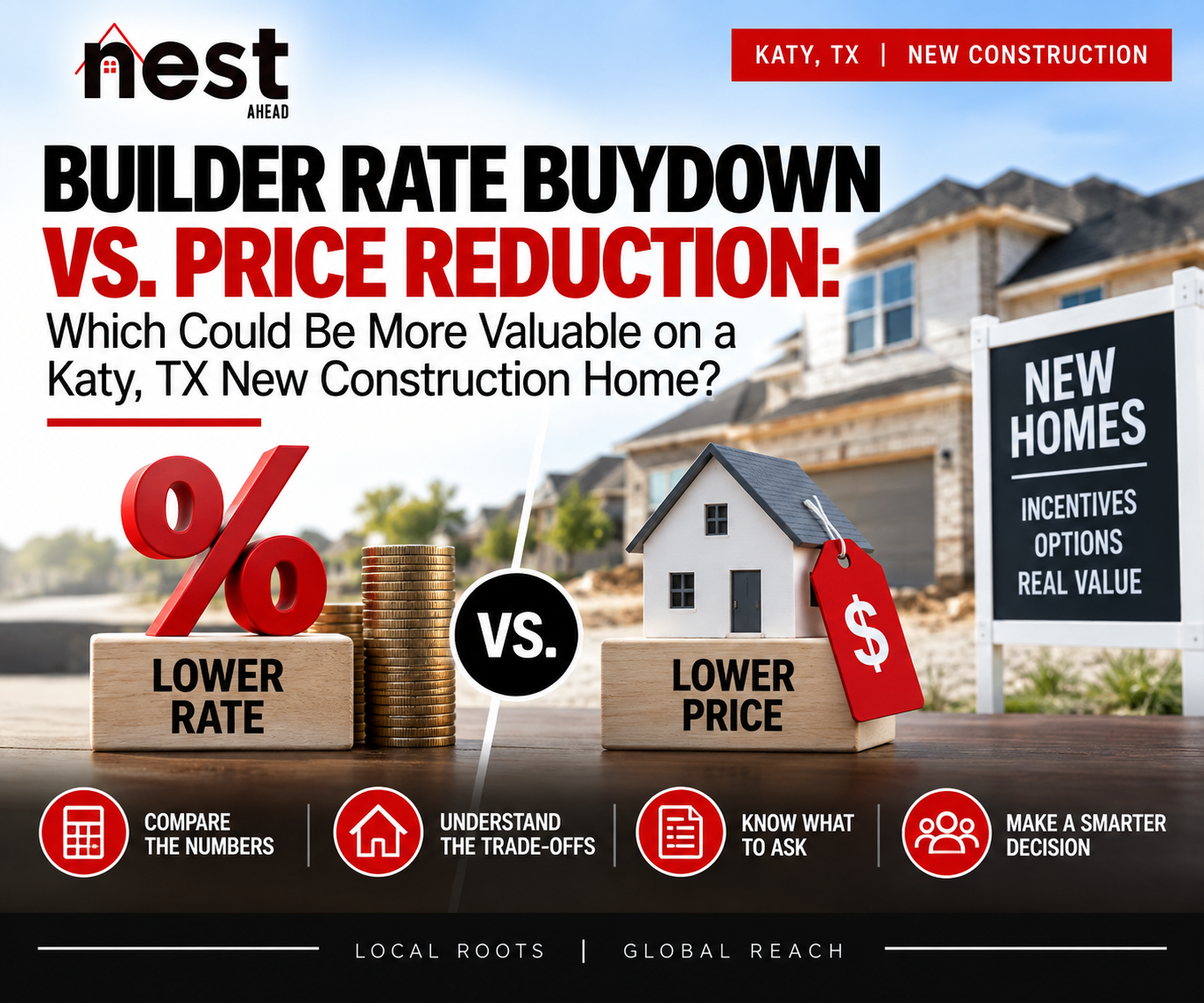
If a Katy, TX homebuilder gives you a choice between a lower mortgage rate and a lower purchase price, which one should you take?
It sounds like a simple math question.
It isn't.
A builder rate incentive can potentially reduce your monthly principal-and-interest payment substantially. A price reduction lowers what you're paying for the home and may reduce the amount you need to finance. Depending on the transaction, closing-cost assistance or another builder incentive could be more valuable than either one.
The right answer depends on the buyer, the home, the financing terms and how the builder has structured the offer.
That's why I don't want my Katy new construction buyers asking only, "Which incentive is bigger?"
I want them asking, "Which option produces the better overall result for me?"
What Is a Builder Mortgage Rate Buydown?
Builders sometimes use incentives to help qualified buyers obtain mortgage financing at an interest rate below prevailing market rates.
There are different ways this can be structured, so the first thing a buyer needs to determine is exactly what the advertised rate represents.
For example, an incentive could involve a permanent rate buydown or a temporary buydown.
Permanent Rate Buydown
With a permanent rate buydown, funds are generally used within the financing transaction to obtain a lower interest rate for the life of that particular mortgage, subject to the loan terms.
If you qualify and keep that mortgage for a long period of time, reducing the interest rate can potentially create meaningful savings in monthly principal and interest over time.
Temporary Rate Buydown
A temporary buydown works differently.
It may reduce the effective payment during the first one, two or several years before the borrower begins making payments based on the full note rate, depending on how the program is structured.
That distinction matters enormously.
A buyer should never look at an advertised builder rate and assume it applies permanently without reviewing the actual financing terms with the lender.
What Does a Builder Price Reduction Do?
A price reduction is easier to understand.
If a builder reduces a home's price from $450,000 to $435,000, the contractual purchase price has been reduced by $15,000.
Depending on the buyer's financing, that may reduce:
- The amount being financed
- The required down payment
- The monthly principal-and-interest payment
- Certain transaction costs that are calculated using the purchase price
However, a $15,000 price reduction does not normally reduce a buyer's monthly mortgage payment by $15,000 divided over the life of the loan.
The buyer is generally financing only a portion of the purchase price, and the effect of the reduction depends on the loan structure.
This is why a relatively modest interest-rate reduction can sometimes produce a larger immediate change in monthly principal and interest than a larger reduction in purchase price.
Why a Lower Rate Can Sometimes Beat a Bigger Price Reduction
Consider a hypothetical buyer choosing between two incentives on the same new construction home.
Option A: The builder reduces the purchase price.
Option B: The builder leaves the price unchanged but provides an incentive that allows a qualified buyer to obtain a lower permanent mortgage rate.
The price reduction may look more valuable because the dollar amount is immediately visible.
But if the lower permanent rate significantly reduces the monthly principal-and-interest payment, a buyer who keeps the mortgage for many years could potentially receive greater financial benefit from the financing incentive.
That does not mean the rate incentive automatically wins.
The actual comparison requires the lender to calculate the financing under both scenarios.
Why a Price Reduction Can Sometimes Be the Better Choice
There are also situations where the price reduction may be more attractive.
For example, a buyer may not expect to keep the original mortgage long enough to realize the potential long-term benefit of paying for a lower permanent interest rate.
The buyer may expect to sell the property relatively soon, or future circumstances may lead to refinancing. Neither outcome should be assumed, but the buyer's expected ownership and financing horizon can be part of the analysis.
A lower purchase price may also affect the amount financed and the buyer's required cash contribution, depending on the loan program.
And there is something psychologically and financially straightforward about simply purchasing the property for less money.
Do Not Compare the Rate Without Looking at the APR and Loan Costs
An advertised mortgage rate is not enough information to compare financing offers.
Buyers should also review the annual percentage rate, commonly called the APR, along with applicable lender charges, discount points and other financing costs.
Ask the lender:
- What is the actual note rate?
- What is the APR?
- Is the rate permanent or temporary?
- Are discount points involved?
- What lender fees apply?
- What loan program is being used?
- What down payment is required?
- What credit and qualification requirements apply?
- Does the buyer have to use the builder's affiliated or preferred lender?
- What happens to the incentive if the buyer uses another lender?
I'm a REALTOR®, not a lender, so I don't advise buyers which mortgage product they should choose. I do, however, want my clients asking the lender the right questions so we can evaluate the real estate transaction with accurate financing information.
What If the Builder Also Offers Closing-Cost Assistance?
This is where the comparison can become even more complicated.
Maybe the choice isn't simply:
Lower rate versus lower price.
It could be:
- Lower mortgage rate
- Price reduction
- Closing-cost contribution
- Upgrade allowance
- Flex Cash
- A combination of incentives
For a buyer who has sufficient income to qualify but wants to preserve cash, allowable closing-cost assistance could be extremely valuable.
For another buyer, reducing the monthly payment may be the priority.
And another buyer may prefer a lower purchase price.
Loan programs and lenders can place restrictions on seller or builder contributions, so the lender should confirm how much of an incentive can actually be used and where it can be applied.
The Monthly Payment Is More Than Principal and Interest
This is particularly important when comparing new construction homes in the Katy area.
A builder may advertise an attractive mortgage rate or estimated principal-and-interest payment, but that is not necessarily the buyer's complete monthly housing expense.
Depending on the property, the overall cost can also include:
- Property taxes
- Homeowners insurance
- Flood insurance when applicable or selected
- HOA assessments
- MUD taxes or other applicable taxing jurisdictions
- Other property-specific expenses
That means two homes with similar purchase prices and mortgage rates can still have meaningfully different overall monthly ownership costs.
Be Careful With the Property Tax Number on a New Construction Home
Property taxes deserve additional attention when evaluating a newly constructed home.
The current or prior-year property tax information available for a new construction property may not reflect the value of the completed house.
Depending on when the home was constructed and the property's status when it was appraised, the historical tax record may primarily reflect the lot rather than the completed home and lot together.
That can make the historical tax bill appear much lower than the taxes a buyer may ultimately experience once the completed improvement is reflected on the tax rolls.
When comparing new construction communities, I want buyers to identify the applicable taxing jurisdictions and understand the combined tax rate rather than simply relying on the previous tax bill displayed online.
Depending on the property's location, taxing entities can include the county, school district, municipal utility district, city and other jurisdictions.
Could the Monthly Mortgage Payment Increase After Closing?
Yes, if property taxes are escrowed, this is something new construction buyers need to understand.
With a fixed-rate mortgage, the principal-and-interest portion of the payment does not increase simply because the property's taxable value increases.
However, the total monthly mortgage payment can increase when the amount being collected through escrow for property taxes increases.
If the initial escrow calculation was based on a tax estimate that turns out to be lower than the actual tax obligation after the completed home is placed on the tax rolls, the mortgage servicer may need to collect more money each month for future property taxes.
There can also be an escrow shortage if insufficient funds were previously collected. Depending on how that shortage is handled, the borrower may have to address the shortage while also funding the higher ongoing escrow requirement.
This is why an attractive initial mortgage payment should never be evaluated without understanding how the property taxes used in that payment estimate were calculated.
Don't Forget the MUD, HOA and Insurance
Katy, TX covers a large geographic area, and the ownership costs associated with one community can differ from another.
A new construction home may be located within a municipal utility district, homeowners association or other taxing jurisdiction.
Insurance costs can also differ based on the property and coverage selected.
So if Builder A offers a lower mortgage rate than Builder B, that doesn't automatically mean Builder A's home will have the lower total monthly housing cost.
The properties themselves have to be compared.
How Long Do You Expect to Keep the Mortgage?
This is one of the questions that can matter when evaluating a permanent rate buydown against other incentives.
A financing incentive that produces savings each month may become increasingly valuable the longer the buyer keeps that particular loan.
If the mortgage is paid off through a sale or refinance relatively quickly, the buyer may receive the benefit for a shorter period.
That doesn't mean anyone should try to predict mortgage rates or assume they will refinance.
It means the buyer and lender can calculate different scenarios and understand where the potential break-even points may occur.
Ask the Lender to Run the Options Side by Side
This is one of the most useful things a buyer can do.
Instead of discussing the incentives abstractly, ask the lender to prepare comparable scenarios.
For example:
- Scenario A: Builder promotional rate
- Scenario B: Reduced purchase price at otherwise available financing
- Scenario C: Closing-cost assistance or another available incentive combination
Then compare the relevant numbers, including:
- Purchase price
- Loan amount
- Interest rate
- APR
- Principal-and-interest payment
- Estimated property taxes
- Estimated homeowners insurance
- Estimated total monthly payment
- Estimated cash needed to close
- Applicable lender costs
Now you're comparing actual scenarios instead of advertising headlines.
Don't Compare the Incentive Without Comparing the House
There is another part of this analysis that sometimes gets lost in the financing conversation.
You are still buying a house.
A fantastic financing incentive doesn't make the wrong property the right property.
Buyers should still evaluate factors such as:
- Location
- Floor plan
- Lot
- Construction and included features
- Community amenities
- Taxing jurisdictions
- HOA
- Insurance considerations
- Available inventory
- Comparable alternatives
- Long-term suitability for the buyer
A slightly less attractive incentive on a home that fits your needs significantly better may ultimately make more sense than chasing the largest promotion.
The Biggest Builder Incentive Isn't Necessarily the Best Deal
That's the main takeaway.
Builder incentives can create legitimate opportunities for Katy, TX new construction buyers, particularly when builders are willing to use their resources to reduce financing costs or help with allowable transaction expenses.
But there isn't one incentive that's automatically best for every buyer.
The best approach is to compare the purchase price, financing, cash requirements, monthly ownership costs and the property itself.
That's also why I want my clients working with their lender and REALTOR® together rather than making a decision based solely on the promotion displayed in the model home.
Read My Complete Guide to Katy, TX Builder Incentives
This article focuses specifically on comparing a builder rate incentive with a price reduction.
For a broader look at promotional rates, closing-cost assistance, price reductions, upgrades, Flex Cash, inventory homes, property taxes and other considerations, read my complete guide: That Builder Incentive Isn't Free: How to Compare a Katy, TX New Construction Deal.
Considering New Construction in Katy, TX?
If you're thinking about buying a new construction home, I would much rather become involved before your first visit to the builder than after you've already selected a home or started paperwork.
Builder policies concerning REALTOR® registration and representation can vary, so don't assume your REALTOR® can simply be added later.
I can help you compare communities, available homes, builder incentives and other real estate considerations while your lender helps you evaluate the financing options available to you.
Call or text me at 281-549-8099 or visit Jonathan.NestAhead.com to get started.
Jonathan McNabb, REALTOR®
Broker/Owner, Nest Ahead
Katy, TX and Greater Houston
281-549-8099
Jonathan.NestAhead.com
This article is provided for general real estate education and is not mortgage, lending, tax, legal or insurance advice. Jonathan McNabb and Nest Ahead are not mortgage lenders. Builder incentives, mortgage programs, rates, APRs, pricing and qualification requirements can change without notice. Property taxes, tax rates, assessments, exemptions, escrow requirements, HOA assessments, insurance costs and other ownership expenses vary by property and buyer. Buyers should obtain current information from the applicable builder, lender, taxing authorities and other qualified professionals before making a purchasing or financing decision.

Jonathan McNabb
Broker/Owner | Nest Ahead
or another way