
Categories
Buyer Tips, Home Buying TipsPublished September 17, 2026
That Builder Incentive Isn’t Free: How to Compare a Katy, TX New Construction Deal

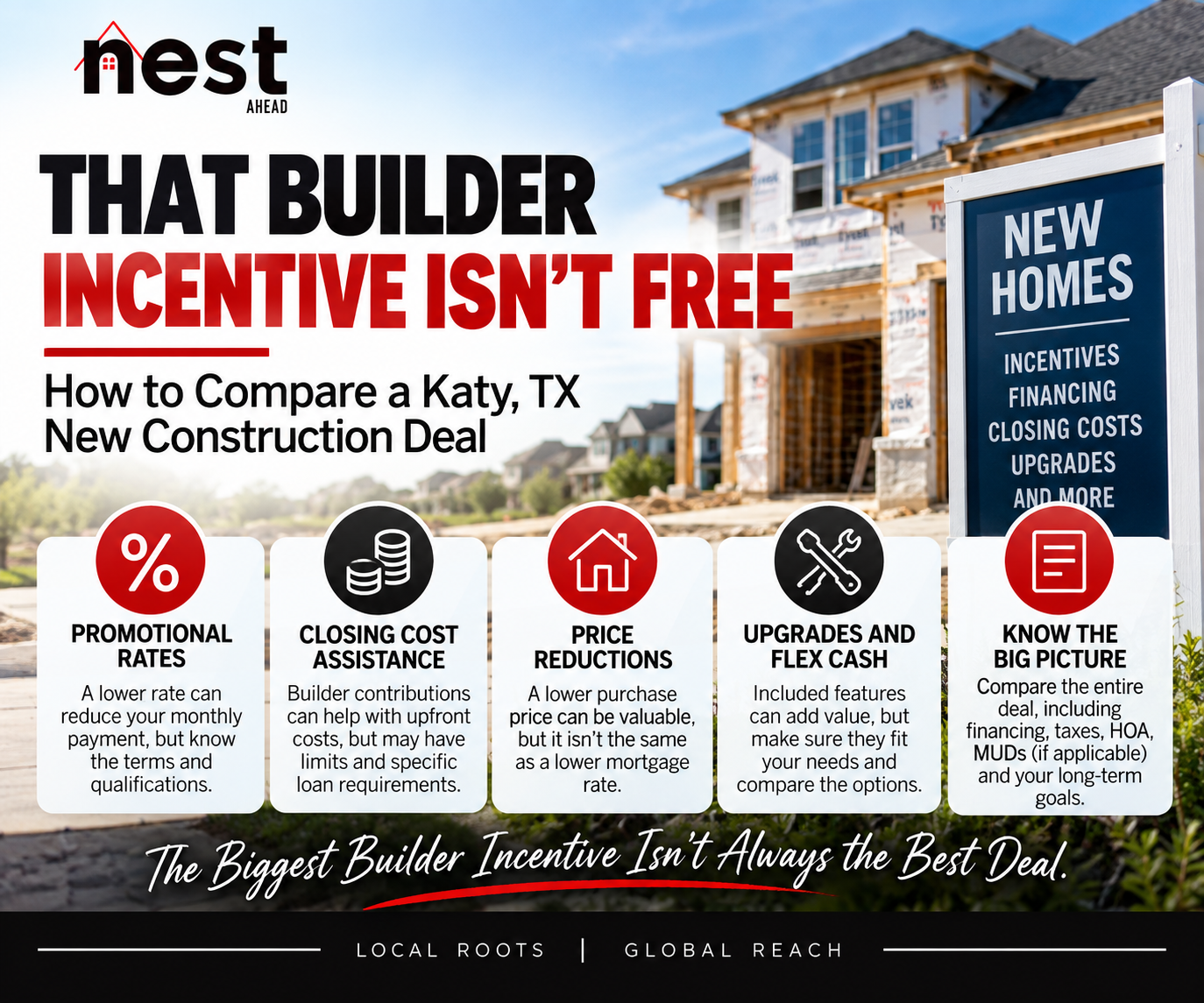
A Katy, TX homebuilder offers you a below-market mortgage rate. Another offers thousands of dollars toward closing costs. A third reduces the price of an inventory home. Which builder is offering the best deal?
The answer may not be obvious.
Builder incentives can be extremely valuable, especially when mortgage rates are elevated. But one of the biggest mistakes I see buyers make with new construction is focusing on the size of the advertised incentive instead of understanding how the entire transaction fits together.
A $20,000 incentive isn't automatically better than a $10,000 incentive. A promotional mortgage rate isn't automatically better than a price reduction. And the lowest advertised home price isn't necessarily the lowest overall cost.
If you're considering new construction in Katy, TX, the goal should be to compare the entire deal, not just the headline.
Why builder incentives matter right now
Financing has become an increasingly important part of the new-construction conversation.
According to Mortgage News Daily, its average top-tier 30-year fixed mortgage rate was 7.24% on September 16, 2026.
That's one reason promotional financing from builders can get so much attention.
As of this writing, for example, some builders marketing homes in the Katy area are advertising promotional financing, Flex Cash, closing-cost assistance or combinations of incentives on qualifying homes.
Those offers can potentially create real value for a buyer. But they also come with terms, qualifications and expiration dates that need to be understood.
The question isn't whether builder incentives are good or bad. The question is which combination makes the most sense for your particular purchase.
Builder incentives come in several different forms
When buyers hear the word "incentive," they sometimes think of it as one big discount. In reality, builders can structure incentives in very different ways.
Depending on the builder, community, home and current promotion, an incentive might include:
- Promotional mortgage rates
- Temporary or permanent rate buydowns
- Closing-cost assistance
- Price reductions on inventory homes
- Design-center or upgrade allowances
- Lot-premium incentives
- Appliance or feature packages
- Flex Cash that may be applied toward qualifying transaction costs
- A combination of several incentives
That sounds great, and it certainly can be. The important part is understanding what each incentive is actually worth to you.
A lower mortgage rate can be worth more than it first appears
When market mortgage rates are elevated, an advertised builder rate can be especially attractive because the effect isn't limited to the day you close.
If the promotional financing is a permanent fixed-rate loan and you qualify for it, the lower rate could reduce the principal-and-interest portion of your payment for as long as you keep that particular mortgage.
But don't stop at the advertised percentage.
Ask questions such as:
- Is this a permanent fixed rate or a temporary buydown?
- What loan program is required?
- What credit qualifications apply?
- Is a specific down payment required?
- Does the offer apply to every home or only certain inventory homes?
- Do I have to close by a certain date?
- Is use of the builder's affiliated or preferred lender required?
- What is the APR?
- What lender fees or discount points are associated with the offer?
- Can the financing incentive be combined with the builder's other incentives?
This is also where your lender becomes an important part of the conversation. I'm a REALTOR®, not a lender, so I want my buyers to review the actual financing terms with qualified mortgage professionals rather than make a decision based on an advertisement.
Don't compare a builder's promotional rate directly to a market headline
This is another important distinction.
A national mortgage-rate index and a builder's advertised promotional rate are not necessarily measuring the same thing.
A builder may be using money to subsidize financing through an affiliated or preferred lender. The offer may also be limited to a particular loan type, home, closing date, credit profile or amount of available inventory.
That's why seeing a builder advertise a rate significantly below a national mortgage-rate average doesn't necessarily mean you've discovered a lender offering ordinary market financing at that rate.
You're looking at a builder incentive attached to a real estate transaction.
That can still be an excellent opportunity. It just needs to be evaluated as part of the overall purchase.
What about a price reduction?
Suppose instead of offering additional money toward financing, a builder is willing to reduce the home's purchase price.
That's easy to understand: you're paying less for the property.
But here's where the comparison becomes interesting.
A price reduction doesn't normally reduce a monthly mortgage payment dollar-for-dollar because you're financing only a portion of the purchase price. Meanwhile, money used to obtain a significantly lower permanent interest rate could potentially have a larger effect on the monthly principal-and-interest payment.
On the other hand, a lower purchase price may reduce the amount financed and the cash needed for a down payment, depending on the loan structure. It may also be valuable to a buyer who doesn't expect to keep the mortgage long enough to receive the full long-term benefit of a rate incentive.
There isn't a universal answer.
If you're trying to decide specifically between a builder's financing incentive and a lower purchase price, I break that comparison down further in Builder Rate Buydown vs. Price Reduction: Which Could Be More Valuable on a Katy, TX New Construction Home?
This is why I don't want my buyers choosing an incentive based solely on which number looks bigger.
Closing-cost assistance can solve a completely different problem
For another buyer, the interest rate may not be the biggest obstacle.
Cash needed at closing might be.
A builder contribution toward allowable closing costs could let a qualified buyer preserve cash that otherwise would have been required for the transaction.
Depending on the financing program and lender requirements, allowable contributions may be subject to limits and restrictions. Your lender should explain exactly how much of a builder contribution can be used and where it can be applied.
If a builder advertises a large closing-cost incentive but your loan can't use all of it, the headline number may overstate its value to you.
Upgrades have value, but they're not the same as cash
Builders may also offer design-center allowances or included upgrades.
Maybe that's flooring, cabinetry, countertops, appliances, outdoor living features or another package.
If you were already going to purchase those upgrades, the incentive could be valuable.
But a $15,000 builder upgrade allowance shouldn't automatically be treated as though someone handed you $15,000 in cash or reduced the home's price by $15,000.
The important questions are:
- Would you have selected those upgrades anyway?
- What would they cost outside the builder's pricing structure?
- Are the upgrades already installed on an inventory home?
- Could another available incentive be more useful to you?
Again, we're comparing actual value, not advertising numbers.
The lowest advertised new-construction price may not be the final price
This is another area where buyers can get surprised.
You may see a floor plan advertised online as "starting from" a particular price. That number can be useful for identifying communities that might fit your budget, but it doesn't necessarily represent the price of the home you ultimately build or purchase.
Depending on the property and builder, the final price can be affected by:
- Homesite or lot premiums
- Elevation or exterior selections
- Structural options
- Design-center selections
- Garage configurations
- Covered patios or outdoor features
- Inventory-home pricing
- Builder promotions and incentive packages
That's why I like to compare actual available homes and realistic build scenarios rather than relying only on the starting price shown on a builder's website.
Do Not Let the Current Property Tax Bill Fool You on a New Construction Home
There is another number Katy, TX new construction buyers need to look at carefully: property taxes.
When you are looking at a newly built home, the current or prior-year property tax information may not reflect the value of the completed house. Depending on when construction was completed and when the property was assessed, the tax records may reflect primarily the value of the lot rather than the finished home and lot together.
That can make the historical tax bill look surprisingly low.
Could Your Monthly Mortgage Payment Increase Later?
Yes, and this can surprise new construction buyers who were expecting their monthly payment to remain about the same after closing.
If your property taxes are included in an escrow account as part of your monthly mortgage payment, the amount initially collected for taxes may be based on an estimate that does not ultimately match the tax bill once the completed home is fully reflected on the tax rolls.
With a fixed-rate mortgage, your principal-and-interest payment does not increase simply because the property's taxable value increases. However, your total monthly mortgage payment can increase if the amount your mortgage servicer needs to collect for property taxes through escrow increases.
For example, if the prior tax information primarily reflected the lot before the completed home was added to the tax roll, using that historical tax amount to estimate the future monthly payment could significantly understate the property's eventual tax expense.
Once the completed home is reflected on the tax rolls and the mortgage servicer performs an escrow analysis, the amount collected each month for property taxes may need to increase. If the escrow account also developed a shortage because insufficient funds had previously been collected, the borrower may have to address that shortage in addition to funding the higher ongoing tax amount.
This is why I want new construction buyers to look beyond the initial monthly payment and understand how the estimated property taxes were calculated. A low historical tax bill on a newly constructed home should not automatically be treated as an indication of what the buyer's future tax obligation or escrow payment will be.
For example, seeing a prior tax bill of only a few thousand dollars does not necessarily mean that is a reasonable estimate of what you will pay after purchasing a newly completed home. Once the completed improvement is added to the tax roll, the taxable value can change substantially.
Look at the Tax Rate and the Expected Completed Value
Instead of relying only on the previous owner's tax bill or the amount currently displayed in public records, we help buyers identify the applicable taxing jurisdictions and look at the property's combined tax rate. Depending on the location, those jurisdictions can include the county, school district, municipal utility district (MUD), city and other taxing entities.
From there, a buyer can get a much more realistic picture of what property taxes could look like once the completed home is reflected on the tax rolls. Actual taxes will depend on the property's assessed value, applicable exemptions, tax rates and other factors, so buyers should verify tax information with the appropriate taxing authorities and professionals.
Why This Matters When Comparing Builder Incentives
This is exactly why I do not want a buyer evaluating a new construction home based solely on a promotional mortgage rate or a large builder incentive.
A builder might advertise an attractive monthly principal-and-interest payment, but that is only part of the homeowner's total monthly housing expense. Property taxes, homeowners insurance, HOA assessments and, where applicable, MUD or other assessments can materially affect the actual monthly cost of owning the home.
That is especially important when comparing two new construction communities. A home with the larger incentive or lower advertised mortgage rate is not automatically the less expensive home to own.
The goal is to understand the entire financial picture before you sign the contract, not discover the difference after closing.
Inventory homes can create a different negotiation opportunity
A builder's motivation may also differ depending on whether you're discussing a home that hasn't been built yet or a completed or nearly completed inventory home.
An inventory home represents capital the builder already has tied up in the property.
The builder may have additional reasons to sell certain homes based on construction completion, inventory levels, sales goals or other business considerations.
That doesn't mean every inventory home will be discounted or that every builder will negotiate the same items.
It does mean I want to understand the specific property we're negotiating rather than assume every house in the community carries the same opportunity.
The builder's sales representative works for the builder
This is something buyers should understand before walking into a model home.
The builder's sales representative can be extremely helpful. They know the community, floor plans, available homes, construction process and builder programs.
But the sales representative represents the builder's interests in the transaction.
When I represent a buyer purchasing new construction, my role is different. I'm there to help my client evaluate the property and transaction from the buyer's perspective.
That can include helping compare communities and homes, reviewing available incentives, analyzing comparable sales where appropriate, discussing contract considerations within my role as a REALTOR®, coordinating with the lender and other professionals, helping with inspections and walkthroughs, and negotiating where opportunities exist.
Contact your REALTOR® before you visit the builder
If you're thinking about new construction in Katy, this is one of the most important things I can tell you:
Call me before your first visit to the builder.
Don't wait until you've already toured the models several times, registered online, started discussing a particular home or signed paperwork.
Builder policies concerning REALTOR® representation and registration can vary. I don't want a buyer assuming that an agent can simply be added later in the process.
I'd much rather be involved from the beginning.
That allows us to visit the community together, ask questions, compare the builder's offers and understand what you're considering before you make a commitment.
How I compare builder deals for my Katy buyers
If we're comparing two or three new-construction options, I don't want to stop at purchase price.
I want us to look at the bigger picture, including:
- Actual purchase price
- Builder incentives
- Financing terms
- Estimated cash needed to close
- Estimated monthly payment
- Property taxes and applicable taxing jurisdictions
- HOA dues
- MUD or PID considerations where applicable
- Insurance estimates
- Included features versus upgrades
- Lot premium
- Home completion and required closing date
- Comparable resale and new-construction alternatives
A home with the largest advertised incentive may still not produce the combination of price, payment, cash requirement and property characteristics that's best for you.
Sometimes the best builder incentive isn't the biggest one
Imagine three hypothetical offers:
Builder A: A large closing-cost contribution.
Builder B: A smaller incentive but a significantly reduced permanent mortgage rate for qualified buyers.
Builder C: A reduced inventory-home price with fewer financing incentives.
Which one wins?
I can't answer that without knowing the buyer.
A buyer concerned about monthly payment could reach a different conclusion than someone focused on preserving cash at closing. Someone expecting to own the home for many years could evaluate a permanent rate incentive differently than someone who anticipates moving again relatively soon.
And the homes themselves may not be equivalent.
Real estate isn't purchased on an incentive spreadsheet alone.
Builder incentives can be excellent opportunities
I don't want the headline of this article to give the wrong impression.
When I say a builder incentive "isn't free," I'm not saying buyers should avoid incentives.
Quite the opposite.
Builders can sometimes offer financing or transaction incentives that individual resale sellers simply aren't positioned to replicate. In a higher-rate environment, those programs can make a meaningful difference for qualified buyers.
The point is to understand how the builder is creating the incentive, what conditions come with it, what alternatives you're giving up and what the incentive is actually worth to you.
That's how you turn a promotion into an informed purchasing decision.
Thinking about new construction in Katy, TX?
Katy has a wide range of new-construction options, and the incentives, available inventory and builder programs can change frequently.
If you're considering a new home, I'd be happy to help you compare communities, builders, available homes and the overall economics of the different options.
Please contact me before visiting or registering with a builder so I can be involved from the beginning.
You can learn more about working with me at Jonathan.NestAhead.com or call me at 281-549-8099.
Jonathan McNabb, REALTOR®
Broker/Owner, Nest Ahead
Katy, TX and Greater Houston
281-549-8099
Jonathan.NestAhead.com
Mortgage rates, builder incentives, pricing, inventory and promotional programs can change without notice and may be subject to qualification, loan-program requirements, lender requirements, property restrictions, expiration dates and other terms. Jonathan McNabb and Nest Ahead are not mortgage lenders. Buyers should obtain current terms directly from the applicable builder and lender and consult appropriate professionals regarding financing, legal, tax, insurance and other matters specific to their transaction.

Jonathan McNabb
Broker/Owner | Nest Ahead
or another way