
Categories
Home Buying TipsPublished September 23, 2026
What Should Home Buyers Know About MUD Taxes in Katy, TX?

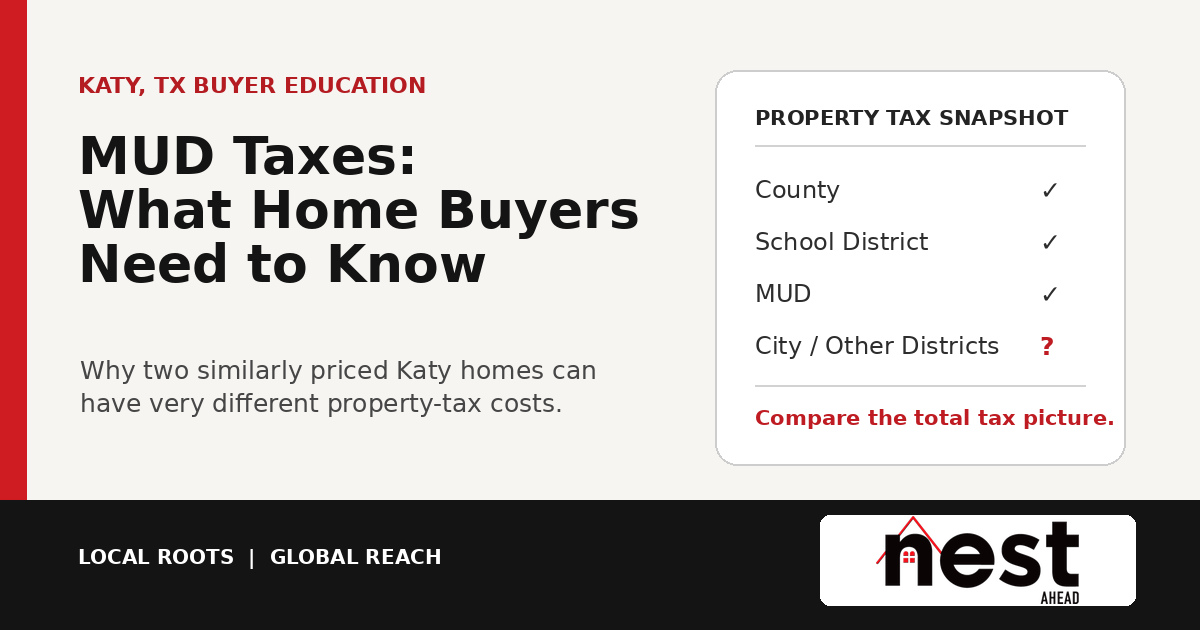
If you are buying a home in Katy, TX, two houses with similar prices can have very different property-tax bills.
One reason is something buyers moving into the Houston area may have never encountered before:
A Municipal Utility District, commonly called a MUD.
You may find one Katy-area home with a particular combination of taxing jurisdictions and another home only a few miles away with a completely different combination.
That matters because the purchase price is only one part of the cost of owning a home.
Before deciding that one Katy, TX home is more affordable than another, buyers should understand the property's applicable taxing jurisdictions and estimated property taxes.
What Is a MUD in Texas?
A Municipal Utility District is a type of special-purpose district that may provide infrastructure and services to properties within its boundaries.
Depending on the district, those functions can involve water, wastewater, drainage and other authorized facilities or services.
MUDs are particularly relevant in growing suburban areas where development may occur outside the utility infrastructure traditionally provided by a municipality.
The Texas Commission on Environmental Quality, commonly called TCEQ, has regulatory responsibilities involving water districts in Texas.
Texas Commission on Environmental Quality: Water Districts
For a home buyer, however, one of the most noticeable effects of being located within a MUD can be the property's tax bill.
Does Every Katy, TX Home Have a MUD Tax?
No.
This is one reason buyers should not make assumptions based solely on a Katy mailing address.
The Katy area extends across multiple counties and contains numerous municipalities, unincorporated areas, subdivisions and special-purpose districts.
Two homes can both have "Katy, TX" in the mailing address and still fall under different taxing jurisdictions.
One property may be located within a MUD.
Another may not.
Two properties that are both within MUDs may be located in different districts with different tax rates.
The address alone does not tell you the complete tax story.
How Does a MUD Affect Property Taxes?
A property within a MUD may have a tax levied by that district in addition to taxes from other applicable taxing jurisdictions.
Depending on the property's location, a tax bill could involve entities such as:
- A county
- A school district
- A Municipal Utility District
- A city, when applicable
- Other special-purpose taxing jurisdictions
The particular combination depends on the property.
That is why I do not want a buyer simply taking a home's purchase price and applying a generic "Katy tax rate."
There is no single property-tax rate that applies to every home with a Katy, TX address.
Why Can MUD Tax Rates Differ?
MUDs can have different financial obligations, tax bases, development stages and operating needs.
For example, a district may issue bonds to finance authorized infrastructure.
Property taxes collected by a district may be used for purposes that include paying eligible debt obligations and supporting district operations, subject to applicable law and the particular district's circumstances.
That means buyers should not assume that because one community has a certain MUD tax rate, another nearby community will have the same rate.
They may be very different.
Can a MUD Tax Rate Change?
Yes.
Tax rates are not necessarily permanent.
A district's rate can change over time based on its circumstances and annual tax-rate process.
That is another reason I prefer to work with current information rather than an old listing, an old closing statement or a tax rate somebody remembers from several years ago.
When you are evaluating a property, verify the current taxing jurisdictions and current rates applicable to that property.
Does a Higher MUD Tax Automatically Make a Home a Bad Purchase?
No.
A higher tax rate is a cost that deserves consideration, but it does not tell you whether a particular home is a good or bad purchase.
Buyers evaluate many factors, including:
- Purchase price
- Property taxes
- Homeowners insurance
- HOA assessments
- Financing
- Home condition
- Location
- Lot
- Features and amenities
- Commute and lifestyle considerations
A home with a higher tax rate may have other characteristics that make it the buyer's preferred choice.
A home with a lower tax rate is not automatically the better value either.
The important thing is knowing about the difference before making the decision.
Why MUD Taxes Matter When Comparing Two Katy Homes
Suppose you are comparing two homes at approximately the same purchase price.
At first glance, the financial decision may appear straightforward.
But if the properties have different combined tax rates, their estimated annual property-tax obligations can differ.
That difference can also affect the amount a lender may collect monthly for an escrow account when property taxes are escrowed.
So when a buyer asks:
"What will my monthly payment be?"
Principal and interest are only part of the conversation.
Depending on the loan and transaction, the total monthly housing expense may also involve property taxes, homeowners insurance, mortgage insurance where applicable, HOA-related costs and other items.
I am a REALTOR®, not a mortgage lender. Your lender should calculate your actual loan payment and financing costs.
My job on the real estate side is to help identify property-specific information that should be part of that conversation.
Be Especially Careful With Property Taxes on New Construction
New construction deserves additional attention.
A current or prior tax bill for a newly constructed home may not necessarily reflect the completed home at its eventual assessed value.
Depending on the timing of construction and appraisal, the tax record may reflect the land or an incomplete improvement rather than the completed house and lot together.
That can make the historical property-tax amount look much lower than what a buyer may experience after the completed home is reflected on the tax roll.
This is why I do not want a new-construction buyer relying solely on the tax amount shown in an old public record or listing.
Instead, we should identify the applicable taxing jurisdictions and current rates and discuss the property's expected value with the appropriate professionals.
Could My Mortgage Payment Increase Later Because of Property Taxes?
If your lender escrows property taxes, changes in the amount needed for taxes can affect the escrow portion of your monthly mortgage payment.
This can be particularly important with new construction.
If an initial escrow calculation is based on tax information that does not yet reflect the completed home, the amount collected for taxes may later need to change after the property is assessed with the completed improvement.
Depending on the circumstances, an escrow analysis could result in a higher monthly escrow payment and could also identify an escrow shortage.
The mortgage lender or servicer determines how the escrow account is calculated and adjusted, so buyers should discuss the property-tax assumptions being used with their lender.
I would rather have a buyer asking about this before closing than being surprised by an escrow adjustment later.
What Is the Difference Between a MUD and an HOA?
These are not the same thing.
A MUD is a governmental district with powers and responsibilities established under Texas law.
An HOA is a homeowners association associated with a community and its deed restrictions, assessments and governance documents.
A property can potentially be subject to both.
That means a buyer could have:
- Property taxes that include a MUD tax, and
- Separate HOA assessments
Do not assume the HOA assessment includes the MUD tax or that paying one eliminates the other.
What Is the Difference Between a MUD and a PID?
You may also encounter the term PID, meaning Public Improvement District.
A PID and a MUD are not interchangeable terms.
They are different mechanisms that can be used in connection with public improvements and development, and their financing and assessment structures can differ.
If a property is located within a PID, I want the buyer to understand the applicable assessment and disclosure information for that particular property rather than treating it as though it were simply another MUD tax.
How Do I Find Out Whether a Katy, TX Home Is in a MUD?
There are several sources we may use when researching a property.
Depending on the property, information may be available through:
- County appraisal district records
- County tax records
- The applicable MUD or water district
- Title documents
- Seller disclosures and statutory notices where applicable
- Other governmental records
Because the Katy area crosses multiple counties, the appropriate source depends on where the property is actually located.
I also want buyers to verify important tax information rather than relying exclusively on a real estate listing.
What Should I Ask Before Buying a Home in a Katy MUD?
If the property is within a MUD, useful questions can include:
- Which MUD serves the property?
- What is the district's current tax rate?
- What other taxing jurisdictions apply?
- What is the combined tax rate?
- What taxable value is being used when estimating taxes?
- Is this new construction where the prior tax bill may not reflect the completed home?
- Are there applicable exemptions the buyer should investigate after ownership?
- How will the lender estimate and escrow property taxes?
The goal is not to turn the buyer into a municipal-finance expert.
The goal is to make sure the buyer understands that the tax number matters.
Does the Homestead Exemption Eliminate MUD Taxes?
No.
Texas homeowners may be eligible for homestead exemptions on a qualifying principal residence, subject to applicable requirements.
But buyers should not assume that a homestead exemption eliminates every property tax or produces the same savings across every taxing jurisdiction.
The Texas Comptroller provides information about property-tax exemptions here:
Texas Comptroller: Property Tax Exemptions
For property-specific exemption questions, buyers should verify eligibility and treatment with the applicable appraisal district and appropriate tax professionals.
Why This Matters for Buyers Relocating to Katy, TX
If you are relocating from another state, the property-tax structure in the Houston area may be unfamiliar.
You might see two similar homes and reasonably assume that because they are both in "Katy," their taxes should be similar.
That assumption can be wrong.
Katy-area properties can be located in different counties, school districts, cities and special-purpose districts.
This is one of the reasons I encourage relocation buyers to compare the complete cost of the properties they are considering rather than comparing purchase prices alone.
What About VA Buyers Purchasing in Katy, TX?
The same property-tax considerations matter if you are purchasing with VA financing.
A VA loan does not make the property's MUD tax disappear, so property taxes remain part of evaluating the cost of the home.
For VA buyers, I want the real estate and financing sides communicating with each other so the lender has the property-specific information needed for its payment and qualification calculations.
If you are a Veteran, active-duty service member or other eligible VA buyer, I have also prepared a detailed guide to choosing an agent familiar with the real estate side of a VA-financed purchase:
How Do I Find a Real Estate Agent Experienced With VA Buyers in Katy, TX?
Buying a Home in Katy, TX?
When I help a buyer compare properties, I do not want to stop at:
"Which house do you like better?"
I also want us asking:
What does each home cost?
What taxing jurisdictions apply?
Is there a MUD?
Is there an HOA?
Is there a PID or another assessment we need to investigate?
What is the condition of the property?
What does the lender need to know?
And how do those pieces fit into your overall home-buying decision?
The goal is not simply to find a house. It is to understand what you are buying before you sign the contract.
If you are considering a home in Katy, TX or the Greater Houston area, call or text me at 281-549-8099 or learn more about working with me at Jonathan.NestAhead.com.
Jonathan McNabb, REALTOR®
Broker/Owner, Nest Ahead
Katy, TX and Greater Houston
281-549-8099
Jonathan.NestAhead.com
Local Roots | Global Reach
This article is provided for general real estate education and is not legal, tax, mortgage, accounting or financial advice. Tax rates, property values, district boundaries, assessments and exemptions can change and vary by property. Buyers should verify property-specific tax information with the appropriate taxing authorities, appraisal district, title company, lender and other qualified professionals as appropriate.

Jonathan McNabb
Broker/Owner | Nest Ahead
or another way