
Categories
Financing & Costs, Katy TX Housing MarketPublished August 13, 2026
Should You Wait for Mortgage Rates to Drop Before Buying in Katy, TX?

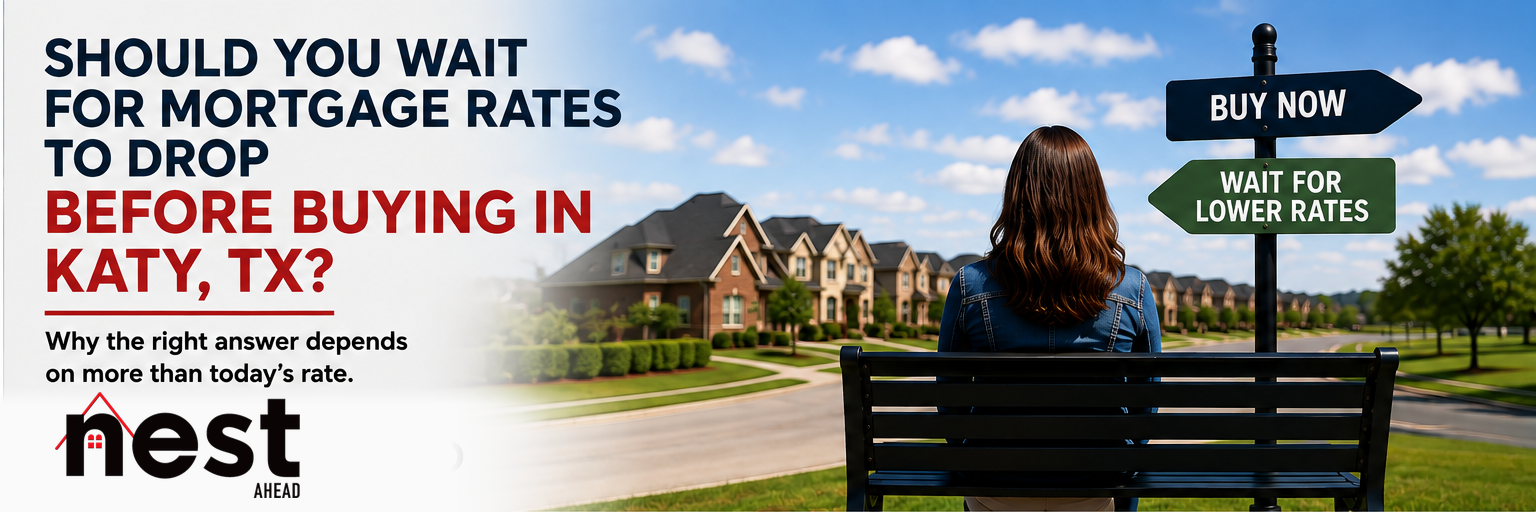
The decision to buy a home in Katy, TX should not depend on one prediction about mortgage rates. A lower rate could improve your payment, but waiting can also change the homes available, their prices, your negotiating position, and your personal timeline.
The practical answer is this: wait if the current payment is not comfortably affordable or you are not financially ready. Do not wait solely because someone predicts that rates must fall soon.
As of August 12, 2026, Mortgage News Daily’s national 30-year fixed-rate index was 6.74%. That was 0.05 percentage point lower than the previous day. It is useful market context, but it is not a rate quote for a particular buyer.
A national mortgage rate is not your mortgage rate
Mortgage-rate headlines summarize part of the market. The rate actually offered to a borrower may depend on:
- Credit profile
- Loan program
- Down payment
- Property type
- Occupancy
- Loan amount
- Discount points or lender credits
- Lock period
- Debt-to-income ratio
- Other lender and underwriting factors
A national index can help you follow the direction of the market. It cannot tell you the exact payment or closing cost associated with your purchase.
Before deciding to buy or wait, request a current loan estimate or detailed payment worksheet from a qualified lender. Compare the interest rate, annual percentage rate, points, lender credits, estimated cash to close, and complete monthly housing expense.
You can follow the current national index through Mortgage News Daily’s 30-year fixed-rate page.
What would a lower rate actually save?
Consider an illustrative $400,000, 30-year fixed-rate loan:
- At 6.74%, principal and interest would be approximately $2,591.73 per month.
- At 6.49%, principal and interest would be approximately $2,525.64 per month.
- The quarter-point reduction would lower principal and interest by approximately $66.09 per month.
That difference matters, but it must be evaluated alongside the complete transaction.
The payment calculation does not include property taxes, homeowners insurance, flood insurance, mortgage insurance, HOA charges, maintenance, or other ownership costs. A buyer could also encounter a different home price, loan amount, seller concession, builder incentive, or closing-cost structure while waiting.
For a closer look at the calculation, read How Much Does a 0.25% Mortgage-Rate Change Affect a Katy, TX Home Payment?.
Waiting changes more than the rate
A buyer who waits is not preserving every other variable.
By the time rates move:
- The preferred home may no longer be available.
- New listings may enter the market.
- The price of a comparable home may change.
- Seller or builder incentives may improve or disappear.
- More buyers may become active.
- The buyer’s income, debts, savings, credit, or employment may change.
- Property taxes, insurance premiums, or HOA costs may differ.
This does not mean buying immediately is always better. It means that waiting is an active market decision, not a way to freeze the current market until financing becomes more favorable.
Katy, TX is not one uniform buying environment
A buyer should not combine every property with a Katy mailing address into one market assumption.
HAR publishes separate market-area reporting for Katy-North, Katy-Southeast, and Katy-Southwest. Individual communities and price ranges can behave differently within those larger areas. Resale homes can also face different competition from new construction, depending on location and buyer preferences.
Review the current Katy-North, Katy-Southeast, and Katy-Southwest reports for market-area context.
Those reports should not be converted into a property-specific conclusion without reviewing the home, its subdivision, competing listings, recent comparable sales, condition, price band, and transaction history.
Waiting may help when affordability is too tight
A buyer should not stretch into an uncomfortable payment merely from fear that a home or rate opportunity will disappear.
Waiting may be appropriate when:
- The complete monthly housing expense exceeds the planned budget.
- The buyer lacks adequate reserves after closing.
- Credit improvement could materially change available financing.
- High-interest debt should be reduced first.
- Employment or income is uncertain.
- The buyer expects a near-term move that would shorten the likely ownership period.
- The available homes do not meet the buyer’s important needs.
- The buyer has not reviewed taxes, insurance, HOA obligations, maintenance, or closing costs.
- The buyer feels pressured to depend on a future refinance to make the payment workable.
A purchase should be sustainable under the financing and expenses available at closing. A possible future refinance can be an opportunity, but it should not be the only reason the initial payment appears manageable.
Buying now may make sense when the numbers already work
A buyer may reasonably proceed when:
- The full payment is comfortable without assuming a future rate reduction.
- Income, credit, funds, and reserves support the purchase.
- The home fits the buyer’s expected ownership horizon.
- The property satisfies needs that may be difficult to replace.
- The price and terms are supported by current comparable evidence.
- Available concessions or credits improve the transaction.
- The buyer understands the market and is prepared to walk away from an unsuitable deal.
The goal is not to buy because rates might rise. It is to determine whether a specific home and financing structure make sense now.
Look beyond price when negotiating
A lower purchase price is valuable, but it is not the only possible negotiation tool.
Depending on the property, seller, loan program, appraisal, contract, and lender requirements, buyers may evaluate:
- Seller contributions toward allowable closing costs
- Funds applied toward an eligible rate buydown
- Repairs or repair credits
- Survey or title-related expenses
- Residential service contracts
- Closing-date flexibility
- Non-realty items when properly documented
- Other terms that affect risk or cash requirements
A concession is not automatically more valuable than a price reduction. The lender should confirm what is permitted and how the proposed concession affects cash to close and monthly payment.
Be careful with temporary buydowns
A temporary buydown can reduce the borrower’s payment during an initial period, but the underlying note rate generally remains in place.
Before relying on one, ask:
- Who is funding it?
- What will the payment be during each period?
- What is the full payment after the temporary reduction ends?
- Must the borrower qualify using the full note-rate payment?
- What happens to unused buydown funds if the loan is refinanced or paid off?
- How does the option compare with a permanent rate reduction or closing-cost credit?
The lower introductory payment should not conceal an unaffordable long-term obligation.
“Buy now and refinance later” is not a guarantee
Refinancing may be possible if rates decline, but future qualification is uncertain.
A refinance can depend on:
- Future mortgage rates
- Property value
- Available equity
- Credit and income
- Employment
- Debt obligations
- Loan-program rules
- Closing costs
- The time needed to recover those costs
The responsible approach is to purchase only when the current transaction works. Treat a future refinance as a possible benefit, not a promised rescue plan.
Compare three scenarios
A useful decision process compares more than one rate forecast.
Scenario 1: Buy under current terms
Document:
- Purchase price
- Loan amount
- Rate and APR
- Complete monthly payment
- Cash to close
- Reserves after closing
- Expected ownership period
- Current concessions or incentives
Scenario 2: Wait and rates decline
Estimate the payment benefit, but also test:
- A different home price
- More buyer competition
- Reduced concessions
- Additional savings accumulated while waiting
- The cost of rent or the current housing arrangement
Scenario 3: Wait and rates do not decline
Consider whether the buyer would still be comfortable buying later and whether delaying affects the family, commute, lease, school-year timing, or other practical needs.
No scenario should be presented as certain. The value of the exercise is identifying which variables matter most.
Frequently asked questions
Will mortgage rates drop soon?
No one can reliably promise the timing, size, or permanence of a future mortgage-rate move. Decisions should be based on present qualification and a range of possible outcomes.
Should I stop searching until rates improve?
Not necessarily. A buyer can use the search process to learn prices, communities, property taxes, insurance considerations, and available inventory without being obligated to purchase.
Can a seller pay to lower my rate?
Seller contributions may sometimes be used toward permitted financing costs or a rate buydown. Availability depends on the contract, loan program, contribution limits, appraisal, lender approval, and transaction structure.
Is the lowest advertised rate always the best option?
No. A lower rate may require discount points or other costs. Compare the rate, APR, lender charges, credits, lock terms, cash to close, and expected ownership period.
Should I buy if I can qualify but the payment feels uncomfortable?
Qualification and comfort are different tests. A lender determines whether a borrower meets program requirements. The buyer must decide whether the complete expense fits the household budget and goals.
The bottom line
Do not attempt to solve a home-buying decision with one rate prediction.
Start with the payment you can comfortably support. Then evaluate the specific home, its Katy, TX submarket, current competition, loan options, closing costs, concessions, reserves, and expected ownership period.
If buying works only after assuming that rates will fall and refinancing will be easy, waiting may be prudent. If the current transaction works without that assumption and the home fits your needs, a future refinance could be an additional opportunity rather than a requirement.
For a property-specific HAR MLS review and coordinated financing conversation, call or text 281.549.8099 or learn more about Jonathan McNabb and Nest Ahead.
Author
Jonathan McNabb, REALTOR®
Broker/Owner, Nest Ahead
Houston native and Katy-area real estate professional serving buyers, sellers, and relocating clients across Greater Houston.
Call or text 281.549.8099
NestAhead.com

Jonathan McNabb
Broker/Owner | Nest Ahead
or another way