
Categories
Seller Advice, Selling Your HomePublished August 22, 2026
What Katy, TX Sellers Must Disclose in 2026: A Complete Guide to the Texas Seller's Disclosure Notice

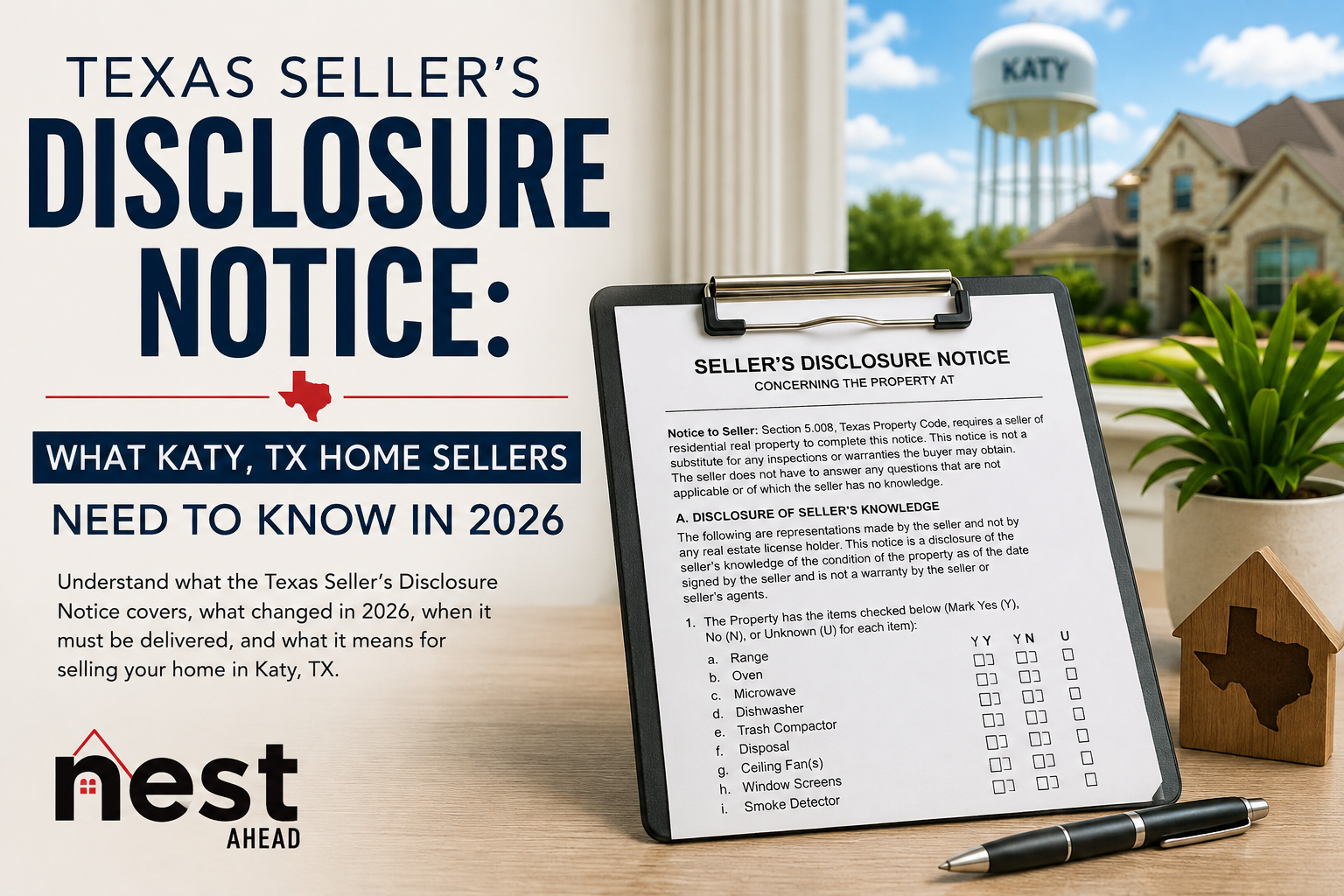
If you are preparing to sell a home in Katy, TX, one of the most important documents you may complete is the Texas Seller’s Disclosure Notice.
At first glance, it can look fairly straightforward. There are checkboxes, questions about the home's systems and condition, and places to provide explanations.
But sellers should take it seriously.
The notice addresses what you know about your property, including its systems, known defects, previous repairs, flooding, insurance, HOA matters, certain easements, storage tanks, and other conditions.
There is another reason Texas sellers should pay particular attention in 2026.
The Texas Real Estate Commission approved a revised Seller’s Disclosure Notice, TREC Form 55-1, effective May 28, 2026. The updated form added several questions that were not on the previous version.
So even if you sold a Texas home a few years ago, don't assume the form looks exactly the same today.
Here's what Katy, TX sellers should know.
What Is the Texas Seller’s Disclosure Notice?
Section 5.008 of the Texas Property Code generally requires a seller of residential real property consisting of not more than one dwelling unit to provide the purchaser with a written disclosure notice, unless an exemption applies.
The current TREC Seller’s Disclosure Notice is Form 55-1.
One of the most important things to understand is what this document is and what it isn't.
The notice expressly states that it is a disclosure of the seller's knowledge of the property's condition as of the date the seller signs it.
It is not a substitute for a buyer's inspections.
It is also not a warranty by the seller or the seller's agents.
That distinction matters.
The seller isn't completing a home inspection. The seller is answering the questions on the notice based on the seller's knowledge and as the form directs.
What Changed on the Texas Seller’s Disclosure Notice in 2026?
TREC approved Form 55-1 in May 2026 to replace Form 55-0.
Several additions are particularly noteworthy.
Insurance
The new form asks whether:
- The property is presently covered by insurance.
- The property is presently covered by windstorm insurance.
- The seller has been unable to insure the property for any reason.
This is an important addition because insurability has become an increasingly significant consideration in real estate transactions.
Private Roads
The form now asks whether there is a private road on or adjoining the property for which the seller is financially responsible for maintenance.
This won't apply to most traditional Katy subdivisions, but it can be relevant to acreage, rural, and less conventional properties in the broader area.
Storage Tanks
The revised notice addresses aboveground and underground storage tanks and separately asks about aboveground tanks holding 500 gallons or more that have stored petroleum products or other chemicals.
Conservation Easements
The form now specifically asks about conservation easements affecting the property.
TREC's form defines a conservation easement as an easement that restricts the use of all or part of a property to protect things such as natural resources, wildlife habitat, open space, or historical sites.
These are meaningful changes, which is why sellers should make sure they're working from the current form rather than an older copy.
What About the New Texas Water Notice?
There was another important Texas form change in 2026, but it should not be confused with the revised Seller’s Disclosure Notice.
TREC created Form 61-0, Water Notice: Seller’s Disclosure About Groundwater and Surface Water Rights, effective July 1, 2026.
The 2026 One to Four Family Residential Contract (Resale) was also revised to address this new water-rights disclosure.
The Water Notice and Seller’s Disclosure Notice are separate forms serving different purposes.
For many traditional subdivision homes in Katy, water rights may seem far removed from the transaction. Still, sellers and their REALTORS® should use the current contract forms and determine which required notices apply to the particular property and transaction.
Flood Questions Are Especially Important for Katy, TX Sellers
The flood section deserves careful attention in the Katy area.
The current Seller’s Disclosure Notice asks sellers about several distinct flood-related matters, including whether they are aware that the property is located wholly or partly in:
- A 100-year floodplain
- A 500-year floodplain
- A floodway
- A flood pool
The form also asks about:
- Present flood insurance coverage
- Previous flooding caused by the failure or breach of a reservoir or a controlled or emergency release of reservoir water
- Previous water penetration into a structure due to a natural flood event
- Whether the seller has ever filed a flood-damage insurance claim on the property
- Whether the seller has ever received FEMA or U.S. Small Business Administration assistance for flood damage to the property
Those are separate questions.
That distinction can be particularly important in the Katy area because of the Barker Reservoir and the flooding associated with Hurricane Harvey.
Flood Pool Location and Flood History Are Not the Same Thing
A property can be located wholly or partly in a reservoir flood pool without the house having previously flooded.
Likewise, a property's history of water penetration is a different question from its FEMA flood-zone designation.
Sellers should answer each applicable question independently and according to what the form actually asks.
Don't Rely Solely on What You Remember From When You Bought the Home
Flood maps, available property information, and seller knowledge can change over time.
If you are unsure about the flood-related questions, don't guess.
Review the actual question, gather the information you have about the property, and seek appropriate professional guidance when necessary.
Previous Flooding Does Not Automatically Make a Home Unsellable
A history of flooding doesn't mean a property cannot be sold.
What matters is giving buyers accurate information so they can evaluate the property and make their own decisions.
Documentation can also be useful.
If a property previously flooded and was repaired, records relating to remediation, repairs, permits, insurance claims, elevation information, or other relevant work may help a prospective buyer better understand what occurred.
MUDs and Special District Notices Are Separate
Many Katy-area properties are located within Municipal Utility Districts or other special districts.
This creates another important distinction:
The Seller’s Disclosure Notice and the statutory notice concerning certain special taxing or assessment districts are not the same document.
Texas Water Code §49.452 requires a person proposing to sell or convey real property located in a district covered by that statute to provide the purchaser with the prescribed written notice.
TREC provides Form 59-0, Notice to Purchaser of Special Taxing or Assessment District, to satisfy those requirements when applicable. TREC also advises that if the district itself makes the required notice available, the seller should use the district's form.
The notice can contain information about the district, its tax rate, bonds, assessments or fees, and other matters prescribed by law.
For Katy sellers, this is important because two homes with similar mailing addresses and sales prices can have different taxing jurisdictions and district obligations.
Don't assume that completing the Seller’s Disclosure Notice takes care of every statutory notice that may apply to the property.
What About the HOA?
The current Seller’s Disclosure Notice asks whether the seller is aware of homeowners association or maintenance fees or assessments.
If a property is subject to mandatory membership in a property owners association, additional contractual and statutory requirements may also apply.
This is another reason I like to identify HOA issues early in the listing process rather than waiting until a buyer is already under contract.
Depending on the transaction, subdivision information and a resale certificate may become important parts of the buyer's due diligence.
Unpermitted Additions and Alterations Matter Too
The Seller’s Disclosure Notice specifically asks whether the seller is aware of room additions, structural modifications, or other alterations or repairs made without necessary permits or not in compliance with building codes in effect at the time.
That can include issues involving things such as:
- Converted garages
- Enclosed patios
- Added rooms
- Structural modifications
- Previous repairs
- Other alterations requiring permits
A seller shouldn't assume that an alteration can be ignored simply because a previous owner performed the work.
The question focuses on what the current seller is aware of.
If you know about something and aren't sure how to answer the form, that is a good time to ask questions before signing it.
When Does the Seller’s Disclosure Notice Have to Be Delivered?
Under Texas Property Code §5.008, the Seller’s Disclosure Notice is to be delivered to the purchaser on or before the effective date of the contract.
That deadline matters.
If the parties enter into a contract without the seller first providing the required notice, the statute gives the buyer a right to terminate the contract for any reason within seven days after receiving the notice.
The current TREC One to Four Family Residential Contract also contains provisions dealing with delivery of the Seller’s Disclosure Notice and the buyer's rights when it has not been delivered.
From a practical listing standpoint, I prefer to address the disclosure before an offer is accepted whenever possible.
That allows prospective buyers to evaluate known property conditions before they decide what they're willing to offer and reduces the chance that a late disclosure creates an additional issue after the contract is already effective.
What If You Learn Something New After Completing the Disclosure?
The Seller’s Disclosure Notice describes the seller's knowledge as of the date it is signed.
But if you learn new material information about your property while it is being marketed or under contract, don't simply assume that the earlier disclosure resolves the issue.
Tell your REALTOR® promptly.
Depending on the facts, the contract, and applicable law, additional disclosure or other action may be appropriate. If there is uncertainty about a legal disclosure obligation, a Texas real estate attorney is the appropriate professional to provide legal advice.
Who Is Exempt From the Seller’s Disclosure Notice?
Texas Property Code §5.008 contains several exemptions.
They include certain transfers:
- Under a court order or foreclosure sale
- By a trustee in bankruptcy
- Involving certain mortgagees or beneficiaries under deeds of trust
- By a fiduciary administering an estate, guardianship, conservatorship, or trust
- Between co-owners
- To a spouse or certain lineal family members
- Between spouses resulting from divorce, legal separation, or related property settlements
- To or from a governmental entity
- Of a new residence that has not previously been occupied for residential purposes
- Where the value of the dwelling does not exceed five percent of the value of the property
Whether a particular transaction qualifies for an exemption can be a legal question.
And an exemption from this particular statutory notice should not be treated as permission to make a false statement or conceal information when another disclosure obligation applies.
When in doubt, seek legal advice.
Can a Seller Answer “Unknown”?
Sometimes, but this needs to be explained carefully.
The current Seller’s Disclosure Notice uses Yes, No, or Unknown for certain questions.
Other sections instruct the seller to answer Yes or No based on whether the seller is aware of the specified condition.
So sellers should not simply use "Unknown" as a universal response throughout the form.
Follow the instructions for the particular question.
Where the form permits "Unknown" and you genuinely do not know the answer, that is an available response.
Where the form asks whether you are aware of a condition and provides Yes or No, answer the question as written.
Most importantly, don't guess and don't use an answer to avoid disclosing something you actually know.
Does a REALTOR® Fill Out the Seller’s Disclosure Notice for the Seller?
No.
This is the seller's disclosure of the seller's knowledge.
The seller signs it.
As a REALTOR®, I can provide the correct form, help a seller understand the real estate process, identify records that may be useful, and point out when a question may require clarification from an appropriate professional.
But I should not substitute my knowledge for the seller's knowledge or decide how the seller should answer a legal disclosure question.
If a seller isn't sure what a question legally requires, I recommend getting advice from a Texas real estate attorney rather than guessing.
How Disclosure Connects to Your Pricing Strategy
Sellers sometimes worry that disclosing a known condition automatically means they must reduce their asking price.
Those are separate decisions.
A REALTOR® doesn't determine a home's value.
What I can do for a seller is analyze comparable sales, competing listings, property characteristics, current inventory, buyer behavior, and other relevant market information to help develop a pricing strategy.
Known property conditions are part of that analysis.
For example, the market may respond differently to:
- An older but functioning roof
- A roof with a known active leak
- A previously repaired foundation with documentation and a transferable warranty
- An unrepaired foundation issue
- A documented prior flood with completed remediation
- An unresolved water-intrusion problem
The appropriate strategy depends on the property, the documentation, competing inventory, buyer expectations, and current market conditions.
Disclosure and pricing work together, but they are not the same thing.
How Disclosure Connects to the Option Period and Inspection
A Seller’s Disclosure Notice and a buyer's inspection also serve different purposes.
The disclosure tells the buyer what the seller knows, as addressed by the form.
An inspection allows the buyer to hire an inspector to independently evaluate the property within the scope of that inspection.
Even a seller who completes the disclosure carefully may not know about every condition an inspector later discovers.
That's normal.
A thorough disclosure can reduce surprises because the buyer enters the transaction already aware of the conditions the seller knows about. The inspection may still reveal additional issues that were previously unknown.
From there, the buyer may decide whether to make a repair request during the option period.
Remember:
Seller's Disclosure Notice ≠ home inspection
and
Home inspection report ≠ repair request
Each serves a different purpose in the transaction.
A Pre-Listing Disclosure Checklist for Katy, TX Sellers
Before completing your Seller’s Disclosure Notice, it can help to gather information you already have about the property.
Consider looking for:
- Roof age and repair or replacement records
- HVAC age and service records
- Foundation repair documentation and transferable warranties
- Insurance claim information involving the property
- Information concerning any difficulty obtaining property insurance
- Plumbing repair records, including slab leaks or repiping
- Records concerning additions, structural modifications, and permits
- Flood information applicable to the property
- Information concerning reservoir flood-pool location
- Known flood or water-penetration history
- Termite or wood-destroying insect treatment records
- Pool and spa information, if applicable
- Septic-system information, if applicable
- Well information, if applicable
- HOA information and known assessments
- Applicable MUD or special-district information
- Known easements, including conservation easements
- Information concerning storage tanks, if applicable
- Information concerning private-road maintenance obligations, if applicable
- Information about known lawsuits, violations, or other matters specifically addressed by the current disclosure form
The point isn't to conduct your own inspection.
It's to gather the information you already have so you can answer the current form thoughtfully and accurately.
Frequently Asked Questions
What is the Texas Seller’s Disclosure Notice?
The Seller’s Disclosure Notice is a written disclosure generally required under Texas Property Code §5.008 for the sale of residential real property consisting of not more than one dwelling unit, unless an exemption applies. The current TREC version is Form 55-1.
What changed on the Texas Seller’s Disclosure Notice in 2026?
TREC's Form 55-1 became effective May 28, 2026 and replaced Form 55-0. The revised form added questions involving current property insurance and windstorm coverage, inability to obtain insurance, certain private-road maintenance obligations, storage tanks, and conservation easements.
Is the 2026 Water Notice part of the Seller’s Disclosure Notice?
No. TREC Form 61-0, Water Notice: Seller’s Disclosure About Groundwater and Surface Water Rights, is a separate form. It became effective July 1, 2026.
Do I have to disclose that my Katy home is in a reservoir flood pool?
The current Seller’s Disclosure Notice specifically asks whether the seller is aware that the property is located wholly or partly in a flood pool. That is separate from questions about previous flooding, flood insurance claims, and FEMA floodplain designations.
Does previous flooding mean my Katy home can't be sold?
No. Previous flooding does not by itself prevent a property from being sold. Buyers can evaluate disclosed flood history, repairs, remediation documentation, insurance considerations, and other property-specific information when deciding whether and on what terms to purchase.
Can I answer “Unknown” on the Seller’s Disclosure Notice?
For questions where the current form provides "Unknown" as an available response, yes, if you genuinely do not know. Other sections use Yes/No awareness questions, so follow the instructions for each individual section rather than treating "Unknown" as universally available.
When must a Texas seller deliver the Seller’s Disclosure Notice?
Texas Property Code §5.008 requires the notice to be delivered on or before the effective date of the contract. If the required notice is delivered after the contract becomes effective, the statute provides the buyer a seven-day termination right after receiving it.
Does my REALTOR® fill out the Seller’s Disclosure Notice for me?
No. It is the seller's disclosure based on the seller's knowledge, and the seller signs it. A REALTOR® can provide the form and assist with the real estate process, but the seller is responsible for the seller's answers.
Does a home in a Katy MUD require another notice?
Properties located within districts covered by Texas Water Code §49.452 are subject to a separate Notice to Purchaser of Special Taxing or Assessment District. TREC provides Form 59-0 when applicable, although TREC advises sellers to use the district's own notice when the district makes one available.
Is a Seller’s Disclosure Notice the same as a home inspection?
No. The Seller’s Disclosure Notice communicates the seller's knowledge as addressed by the form. A buyer's inspection is an independent evaluation performed within the scope of the inspection. One does not replace the other.
Should I get a pre-listing inspection before completing my disclosure?
Texas law does not generally require a seller to obtain a home inspection simply to complete the Seller’s Disclosure Notice. Whether a pre-listing inspection makes sense is a separate strategy decision. Sellers considering one should understand that it may provide them with additional information about the property's condition that they did not previously know.
The Bottom Line for Katy, TX Home Sellers
The Seller’s Disclosure Notice isn't something I recommend rushing through the night before your home goes on the market.
Read each question.
Use the current form.
Answer according to the instructions.
Gather the records you already have.
Don't guess when you genuinely don't know something.
And don't assume that because something happened years ago, was repaired by a previous owner, or doesn't bother you today that it is automatically irrelevant to a question on the disclosure.
For Katy, TX sellers in particular, pay close attention to flood history, reservoir flood-pool questions, insurance, MUD or special-district notices, HOA matters, previous repairs, and property modifications.
Good disclosure doesn't guarantee that an inspection won't uncover something new.
What it does is give the buyer accurate information about what the seller knows, allowing the transaction to begin with fewer avoidable surprises.
Thinking About Selling Your Home in Katy, TX?
Preparing to sell involves much more than deciding on an asking price.
Before your home reaches the market, I can help you work through the listing process, gather important property information, develop a pricing and marketing strategy, and understand what to expect from the contract through closing.
If you're considering selling a home in Katy, TX or the Greater Houston area, call or text me at 281-549-8099.
Jonathan McNabb, REALTOR®
Broker/Owner | Nest Ahead
281-549-8099
NestAhead.com
This article provides general real estate information and is not legal advice. Disclosure obligations can depend on the property, transaction, and individual circumstances. Consult a licensed Texas real estate attorney regarding specific legal questions.
About the Author
Jonathan McNabb, REALTOR® is the Broker/Owner of Nest Ahead and has nearly 30 years of combined experience in the real estate and legal industries. He works with buyers and sellers throughout Katy, TX and the Greater Houston area, helping clients navigate pricing strategy, marketing, offers, negotiations, option periods, inspections, repair requests, appraisals, and closing.
Jonathan's approach emphasizes local market knowledge, preparation, communication, and strategic representation so sellers understand what is happening throughout their transaction, why it matters, and what options may be available as they work toward closing.

Jonathan McNabb
Broker/Owner | Nest Ahead
or another way